Otomat
HomeServicesReturn EngineeringIndustriesPrivate EquityResultsInsightsAbout
Book a Return Review

The Return Multiple

A weekly letter on AI returns and valuation. One lever, finished out loud, every Friday.

Subscribe
Otomat

Otomat — Return Engineering. AI, underwritten.

Underwritten like an investor. Built like an engineer. Run like an operator. AI transformation with investment discipline and continuing operating responsibility.

Company

  • Services
  • Return Engineering
  • AI Operating System
  • Industries
  • Private Equity
  • Results
  • About
  • Insights

Services

  • Fractional Chief AI Officer
  • Operating assessment
  • Embedded transformation
  • Controlled improvement
  • Portable application layer
  • Sponsor operating mandate

Resources

  • AI Restructuring Report
  • AI Operating System Guide
  • AI Consulting vs Restructuring
  • AI Restructuring vs Big 4
  • Fractional vs Full-Time CAIO
  • Insights

Connect

  • Book a Return Review
  • Contact Us
  • adam@otomat.ai

© 2026 Otomat AI, LLC. All rights reserved.

Privacy Policy·Terms of Service

OTOMAT / FIELD EDITION

Operating Notes: decision sheets for AI work

Twelve practical decision sheets for CFOs, operating partners and the people running the work. Read each field test, download the slides or take a one-page graphic to a meeting.

Otomat editorial · 4 November 2026 · Illustrative operating exercises

Subscribe to Operating Notes via RSS

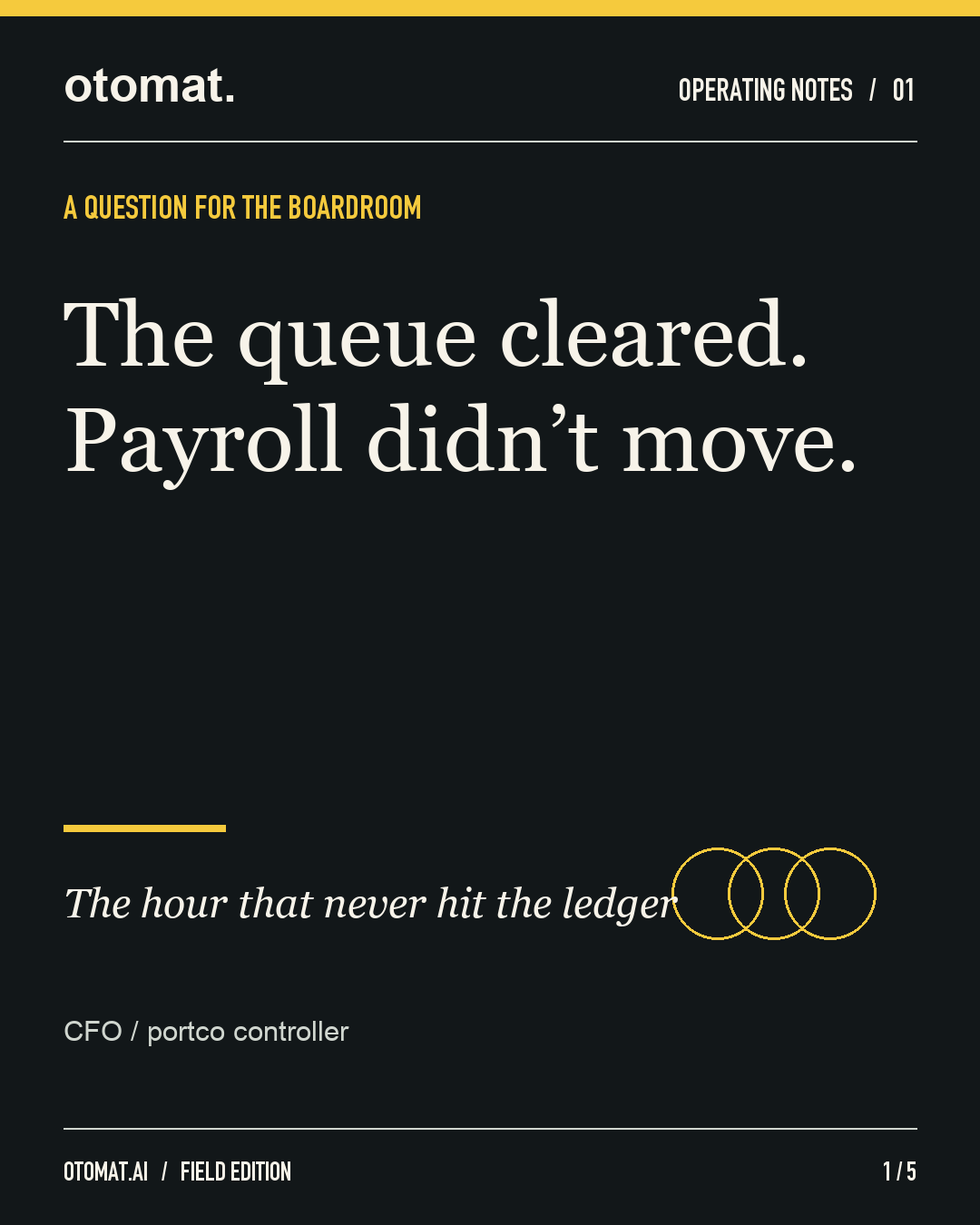
FIELD NOTE 01 / CFO / portco controller

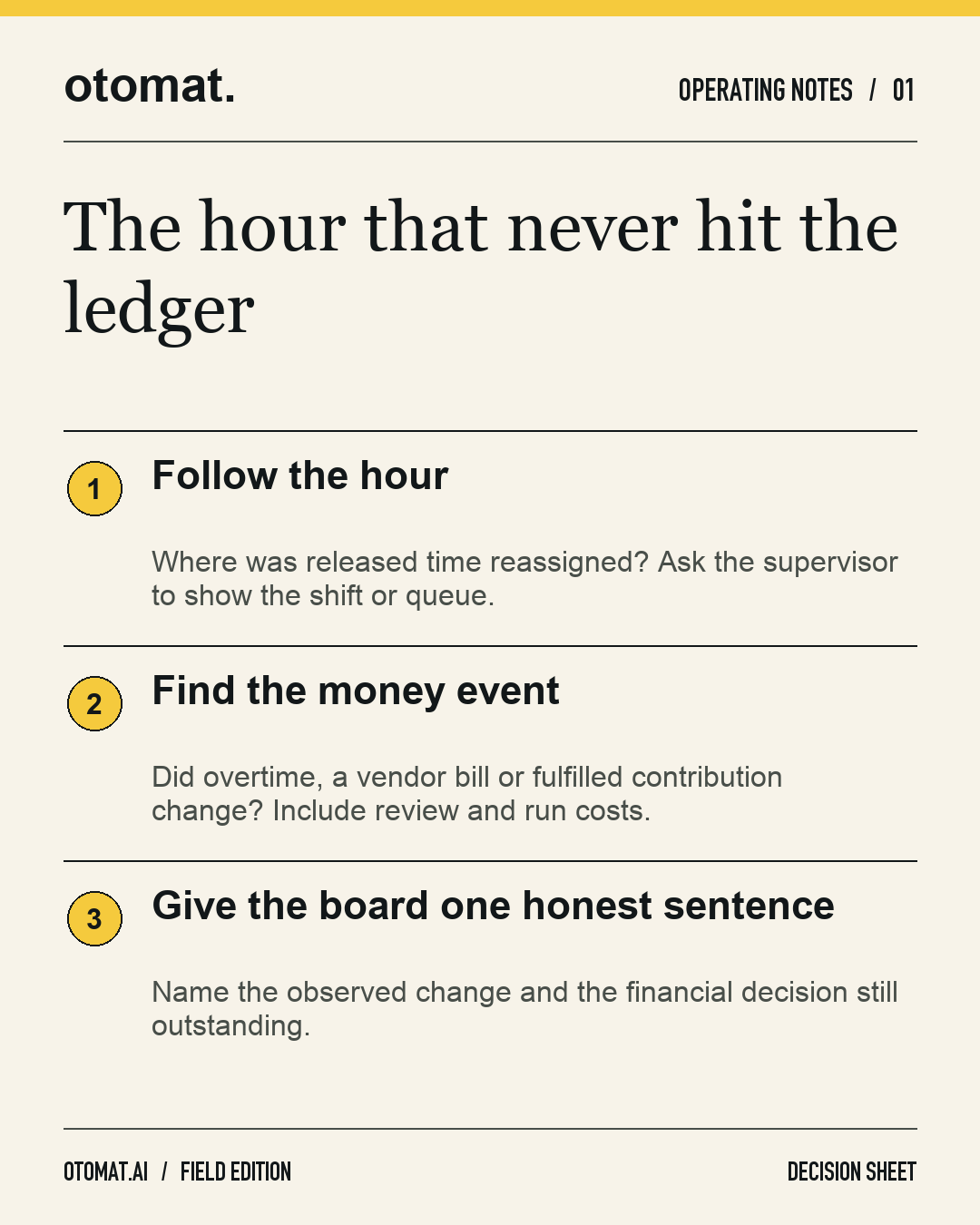
The hour that never hit the ledger

The queue cleared. Payroll didn’t move.

A service desk finishes early and turns to the renewals backlog. That is a useful operating change. Calling it a payroll saving creates a number nobody in finance can trace.

Read the field test
  1. Follow the hour. Where was released time reassigned? Ask the supervisor to show the shift or queue.
  2. Find the money event. Did overtime, a vendor bill or fulfilled contribution change? Include review and run costs.
  3. Give the board one honest sentence. Name the observed change and the financial decision still outstanding.

Which source would make your controller change the board line?
Slides (PDF)Decision sheet (PNG)
Read the full guide →

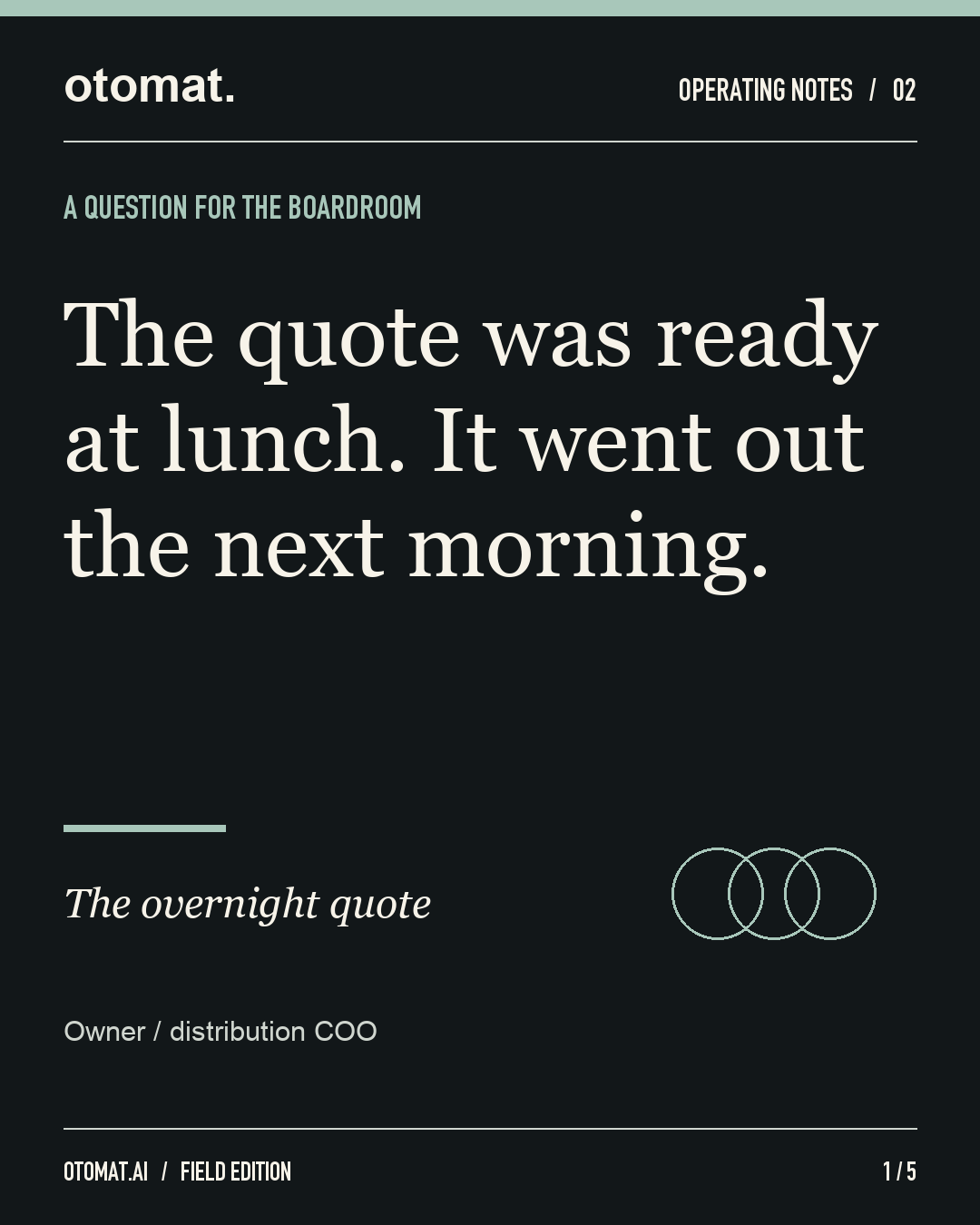
FIELD NOTE 02 / Owner / distribution COO

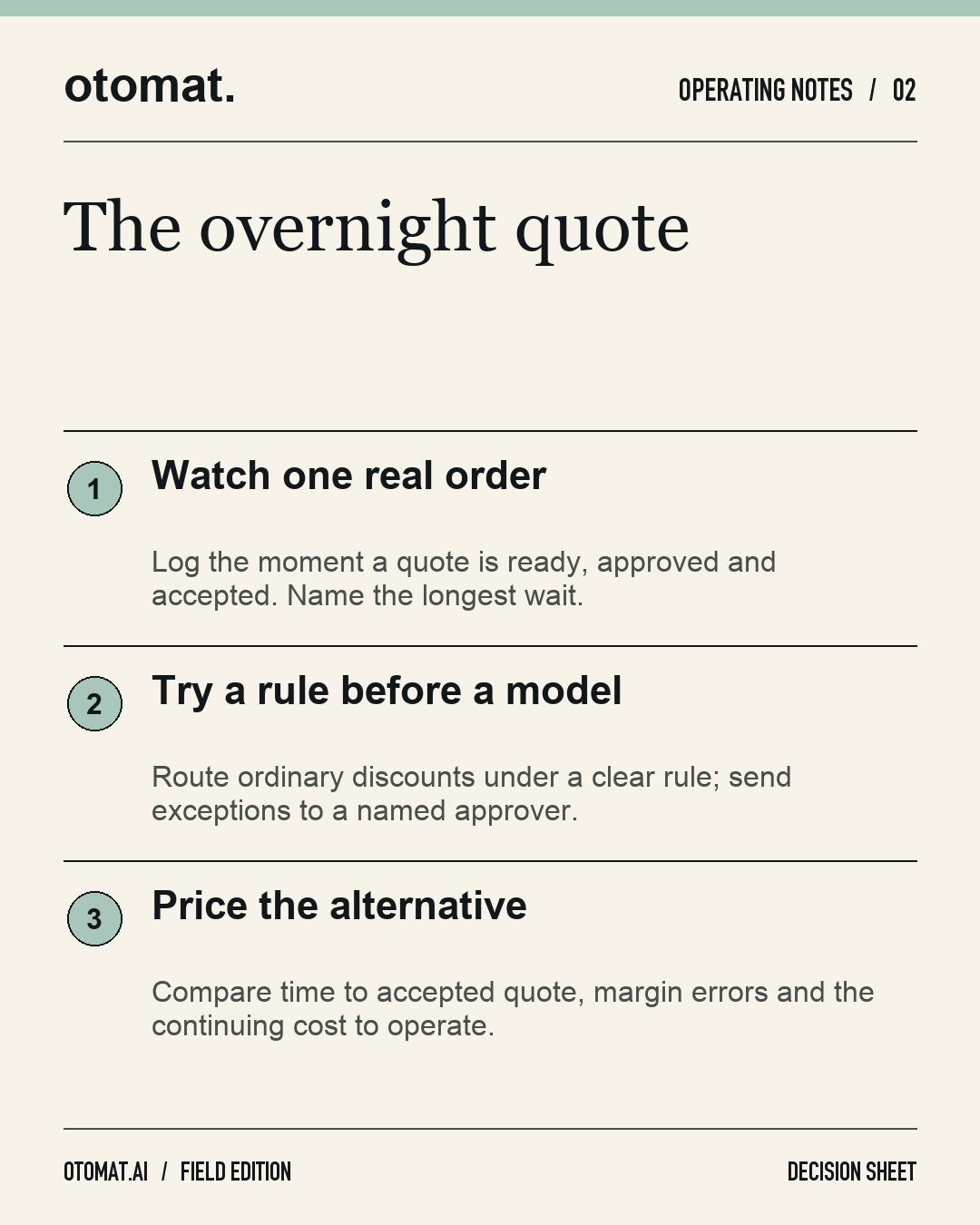
The overnight quote

The quote was ready at lunch. It went out the next morning.

Picture a distributor whose sales team wants AI to write quotes. The draft is ready at noon. Only one person can approve a discount, and that person reviews them the next morning. Faster drafting won’t move the order.

Read the field test
  1. Watch one real order. Log the moment a quote is ready, approved and accepted. Name the longest wait.
  2. Try a rule before a model. Route ordinary discounts under a clear rule; send exceptions to a named approver.
  3. Price the alternative. Compare time to accepted quote, margin errors and the continuing cost to operate.

What would you change first: the draft, the rule or the handoff?

Slides (PDF)Decision sheet (PNG)
Read the full guide →

FIELD NOTE 03 / PE operating partner / GP

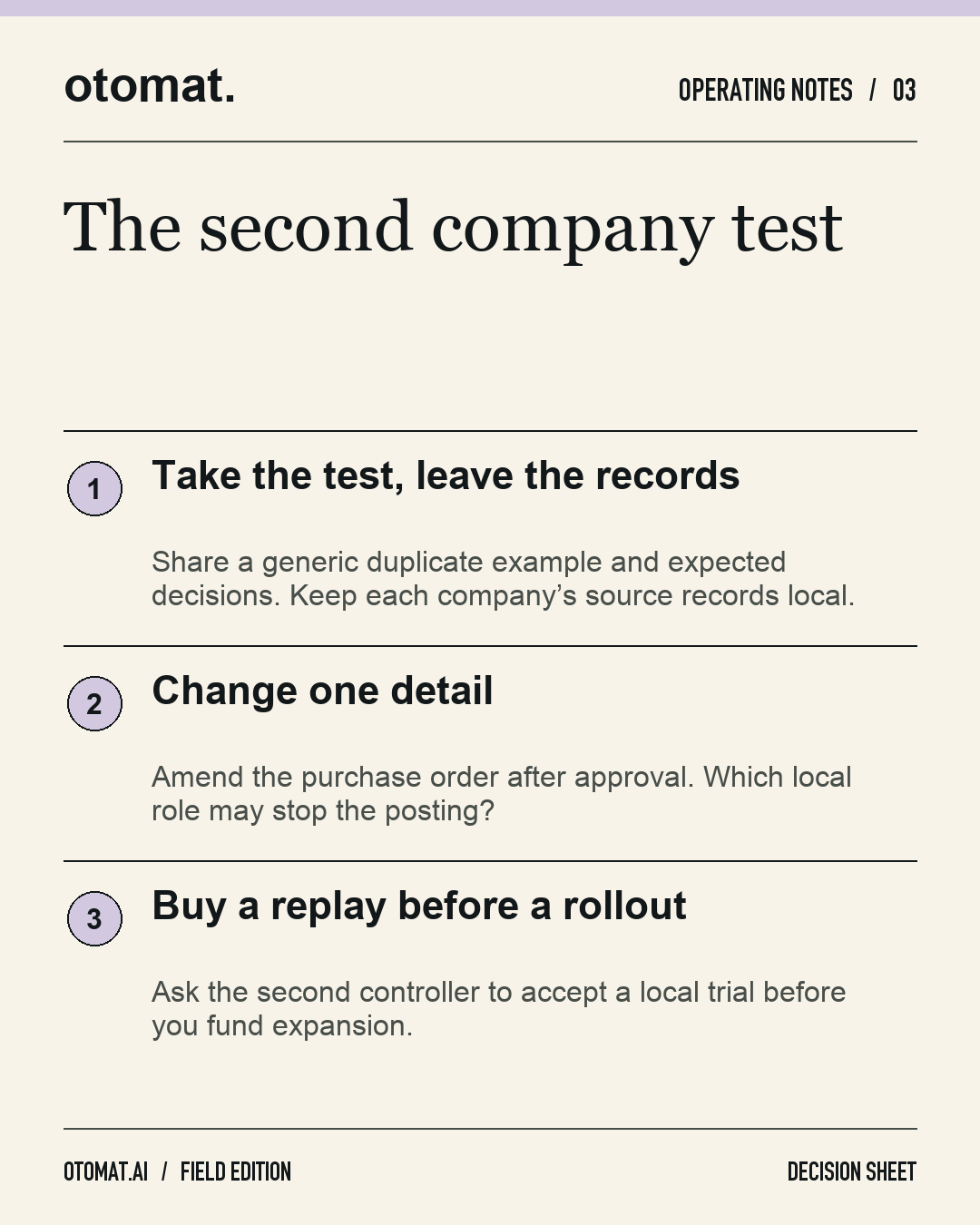
The second company test

Same sponsor. Different invoice.

A duplicate-invoice check works in one company. Its sister company uses the same words for a different approval chain. Copying the integration can silently copy the wrong decision rights.

Read the field test
  1. Take the test, leave the records. Share a generic duplicate example and expected decisions. Keep each company’s source records local.
  2. Change one detail. Amend the purchase order after approval. Which local role may stop the posting?
  3. Buy a replay before a rollout. Ask the second controller to accept a local trial before you fund expansion.

What can the second company reuse without assuming the first company’s rights?

Slides (PDF)Decision sheet (PNG)
Read the full guide →

FIELD NOTE 04 / CIO / portco COO

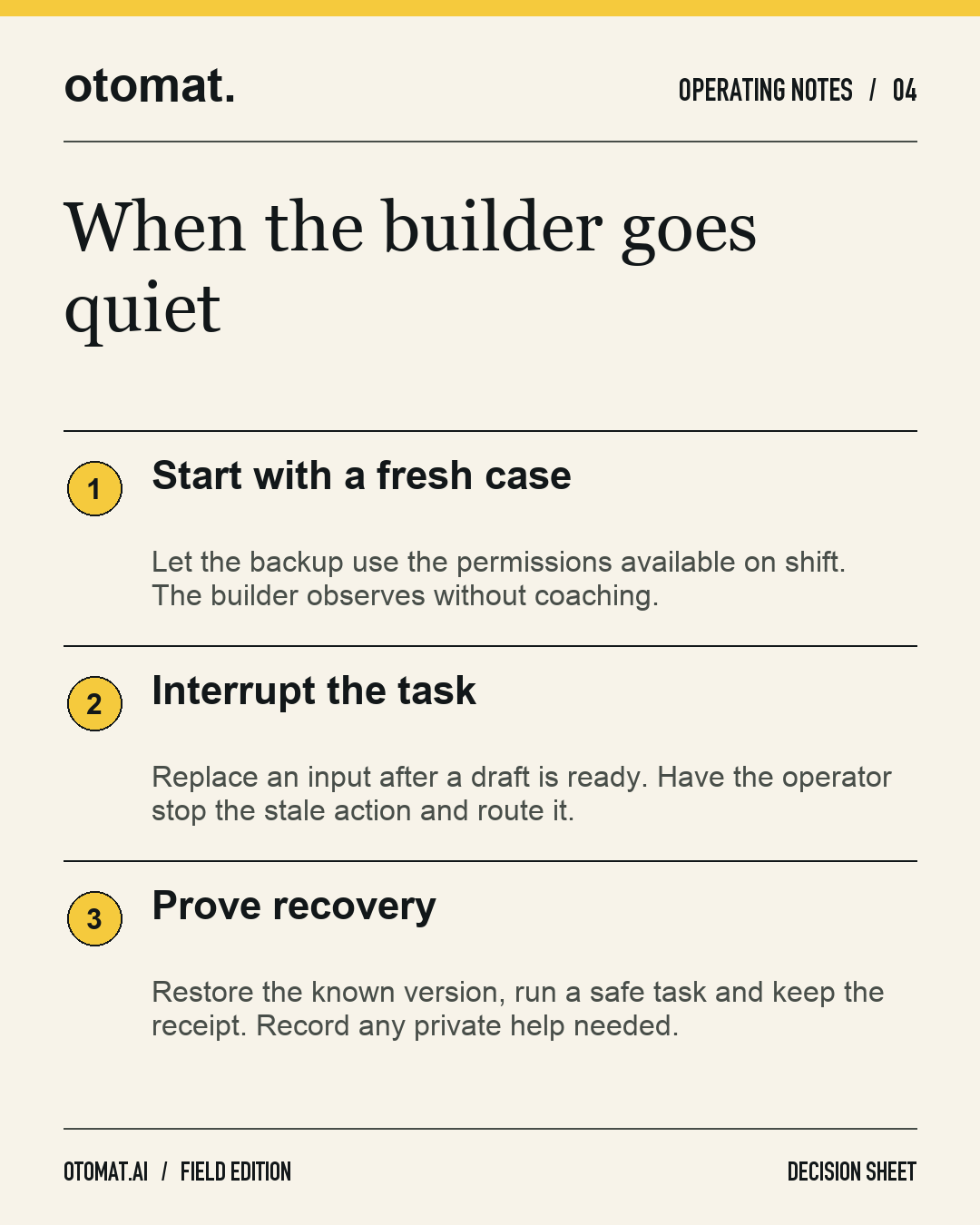
When the builder goes quiet

Give the keyboard to the backup.

In rehearsal, a builder narrates every click. On Monday night the backup has the runbook and a document that has changed twice. Those are different tests.

Read the field test
  1. Start with a fresh case. Let the backup use the permissions available on shift. The builder observes without coaching.
  2. Interrupt the task. Replace an input after a draft is ready. Have the operator stop the stale action and route it.
  3. Prove recovery. Restore the known version, run a safe task and keep the receipt. Record any private help needed.

Who can restore the workflow when your usual expert is away?

Slides (PDF)Decision sheet (PNG)
Read the full guide →

FIELD NOTE 05 / B2B CEO / marketing leader

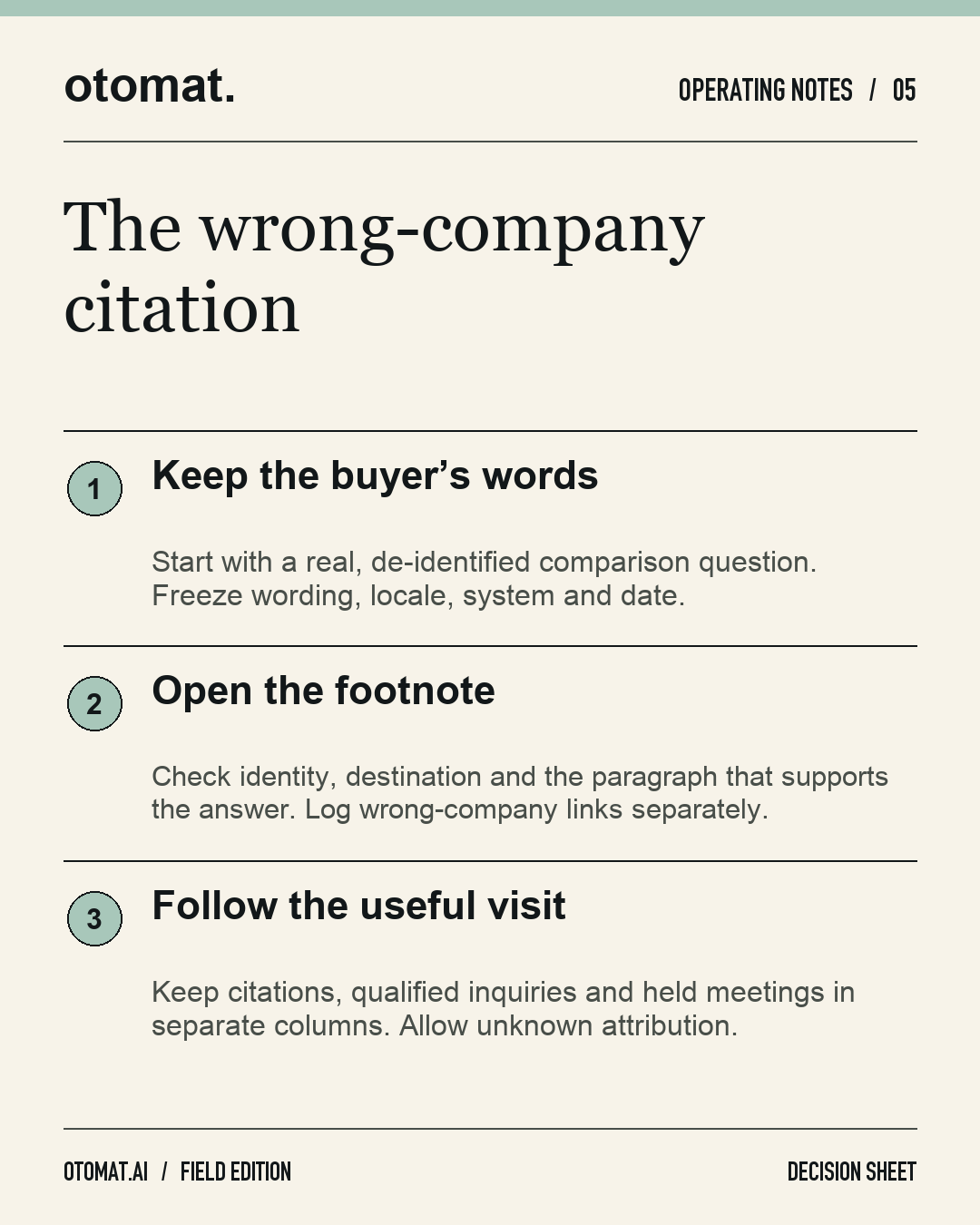
The wrong-company citation

An AI answer named you. The link went to somebody else.

A business with a familiar name can get a flattering mention that sends the buyer elsewhere. A mention count would celebrate exactly the thing you should fix.

Read the field test
  1. Keep the buyer’s words. Start with a real, de-identified comparison question. Freeze wording, locale, system and date.
  2. Open the footnote. Check identity, destination and the paragraph that supports the answer. Log wrong-company links separately.
  3. Follow the useful visit. Keep citations, qualified inquiries and held meetings in separate columns. Allow unknown attribution.

Which buyer question would you actually want your company cited for?

Slides (PDF)Decision sheet (PNG)
Read the full guide →

FIELD NOTE 06 / Deal team / independent sponsor

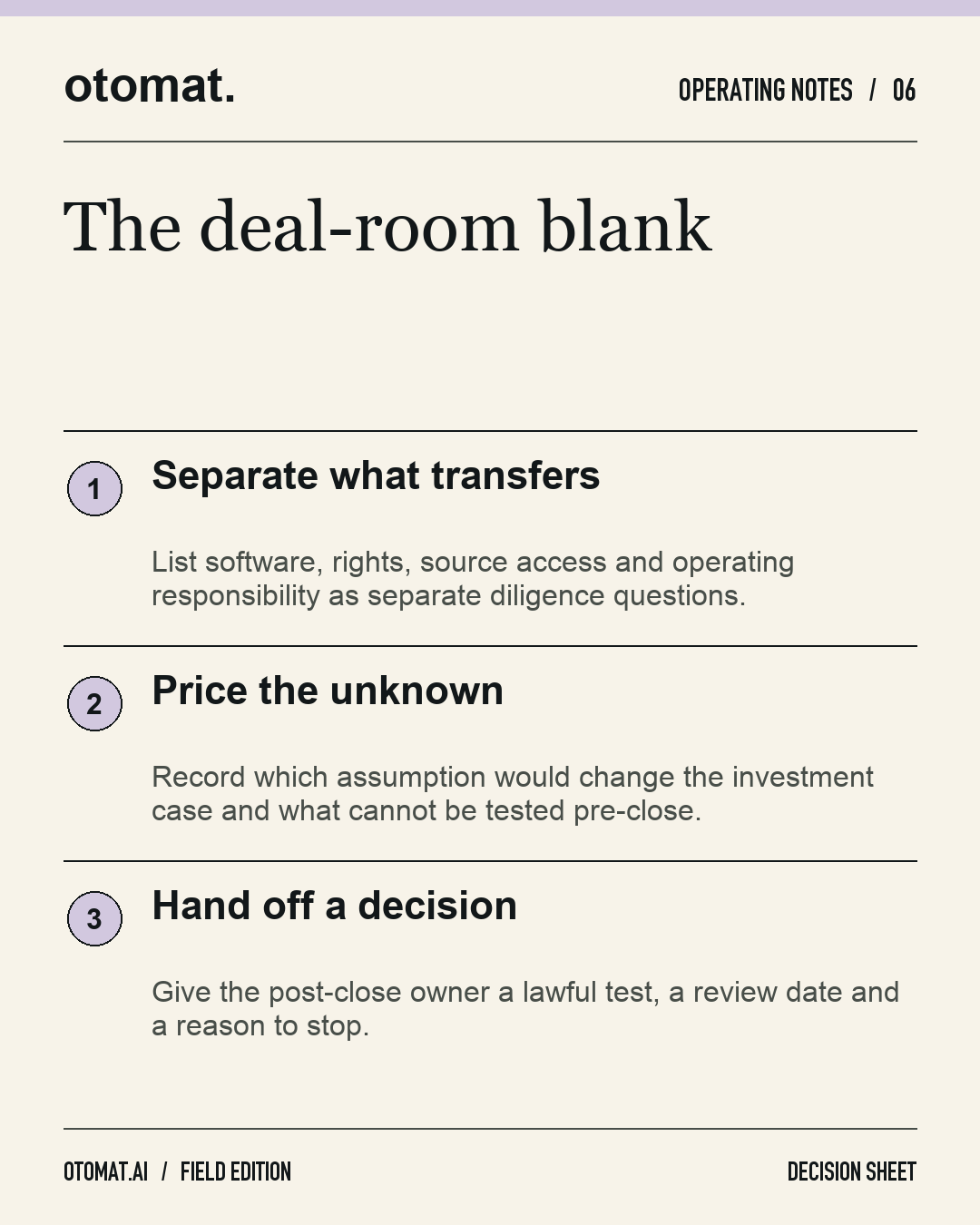
The deal-room blank

The seller’s demo has a missing column: rights after close.

A diligence room contains a convincing workflow demo. The buyer may acquire the software but not the right to use the underlying records for the proposed purpose. A good demo does not resolve that dependency.

Read the field test
  1. Separate what transfers. List software, rights, source access and operating responsibility as separate diligence questions.
  2. Price the unknown. Record which assumption would change the investment case and what cannot be tested pre-close.
  3. Hand off a decision. Give the post-close owner a lawful test, a review date and a reason to stop.

Which assumption in your investment memo needs its own post-close test?

Slides (PDF)Decision sheet (PNG)
Read the full guide →

FIELD NOTE 07 / Retail COO / customer operations

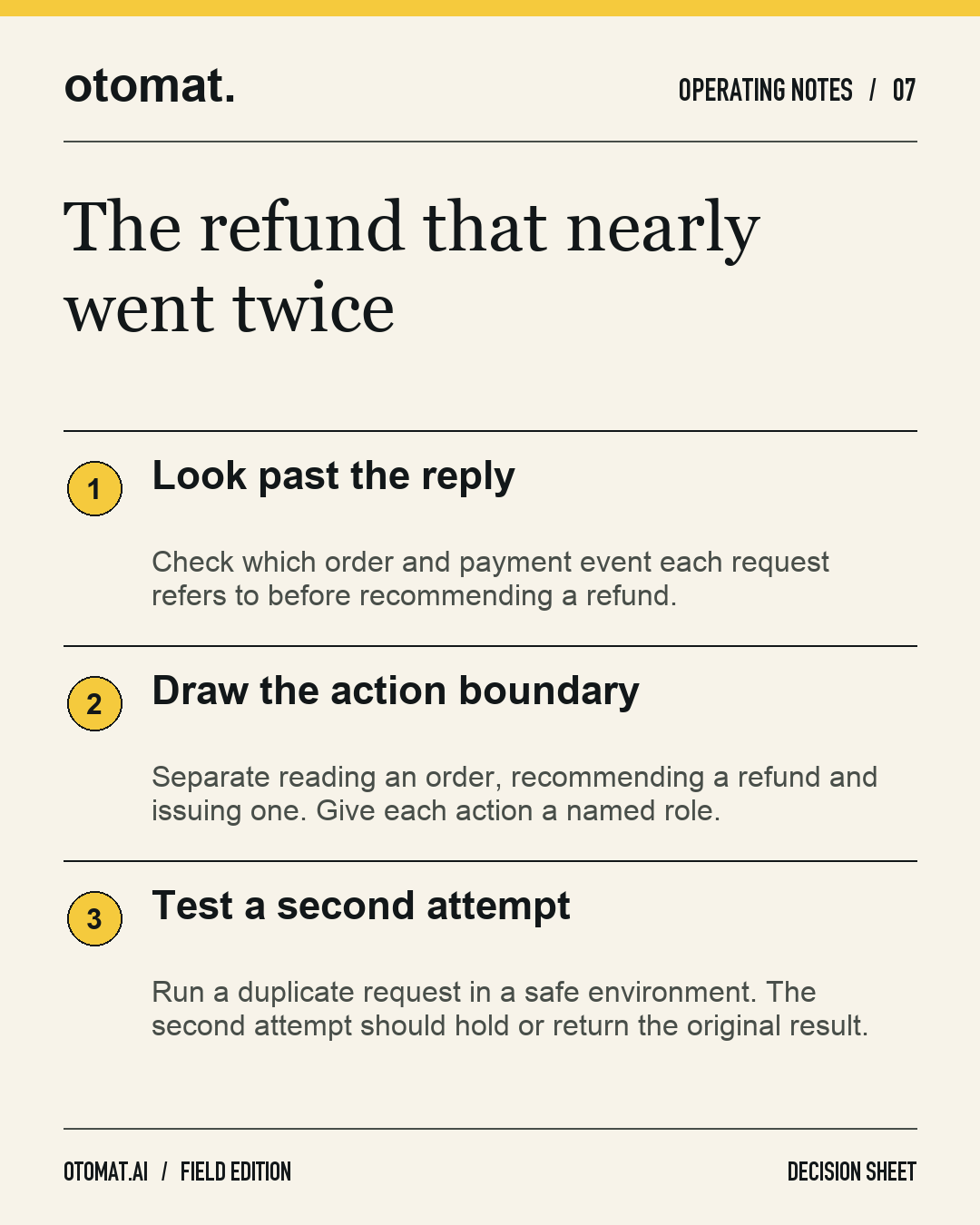
The refund that nearly went twice

One return. Two open refund requests.

Picture an online retailer with two customer service channels. The customer opens a chat after sending an email. Both agents see a valid return. An AI response can sound perfect while the money goes out twice.

Read the field test
  1. Look past the reply. Check which order and payment event each request refers to before recommending a refund.
  2. Draw the action boundary. Separate reading an order, recommending a refund and issuing one. Give each action a named role.
  3. Test a second attempt. Run a duplicate request in a safe environment. The second attempt should hold or return the original result.

What stops a perfectly plausible second refund?

Slides (PDF)Decision sheet (PNG)
Read the full guide →

FIELD NOTE 08 / CTO / procurement

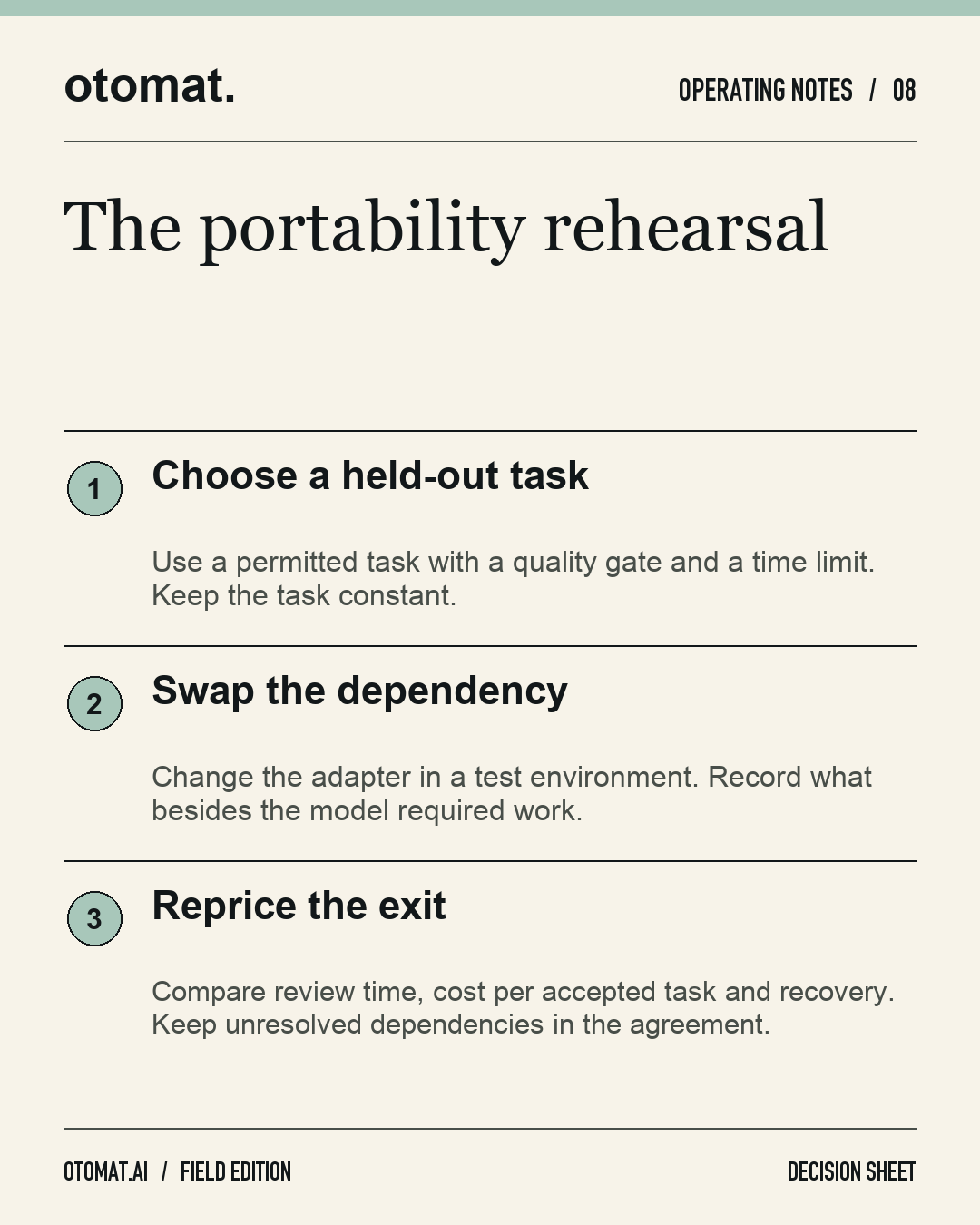
The portability rehearsal

You own the code. Can you leave the model?

A contract says the customer owns the application. A provider change can still strand prompts, evaluations or retrieval settings. Test the dependency while you have both providers available.

Read the field test
  1. Choose a held-out task. Use a permitted task with a quality gate and a time limit. Keep the task constant.
  2. Swap the dependency. Change the adapter in a test environment. Record what besides the model required work.
  3. Reprice the exit. Compare review time, cost per accepted task and recovery. Keep unresolved dependencies in the agreement.

What would your next provider inherit besides a repository?

Slides (PDF)Decision sheet (PNG)
Read the full guide →

FIELD NOTE 09 / COO / workforce leader

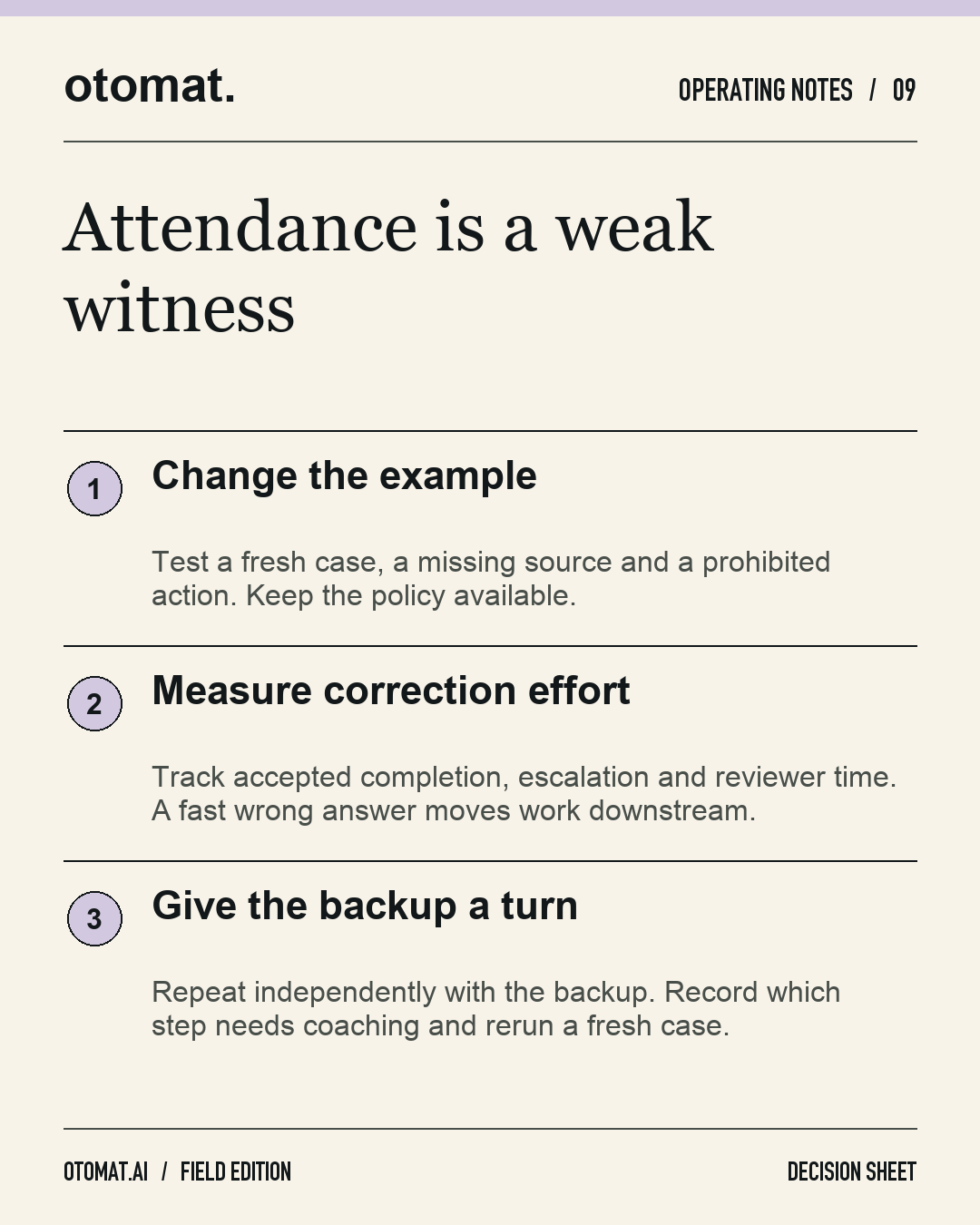
Attendance is a weak witness

A full training room cannot run the late shift.

A new operator handles every practice case after the trainer demonstrates it. The first unseen exception arrives after hours. That is the moment the training plan should have prepared for.

Read the field test
  1. Change the example. Test a fresh case, a missing source and a prohibited action. Keep the policy available.
  2. Measure correction effort. Track accepted completion, escalation and reviewer time. A fast wrong answer moves work downstream.
  3. Give the backup a turn. Repeat independently with the backup. Record which step needs coaching and rerun a fresh case.

Which task can a new operator complete without a trainer?

Slides (PDF)Decision sheet (PNG)
Read the full guide →

FIELD NOTE 10 / GP platform lead / CIO

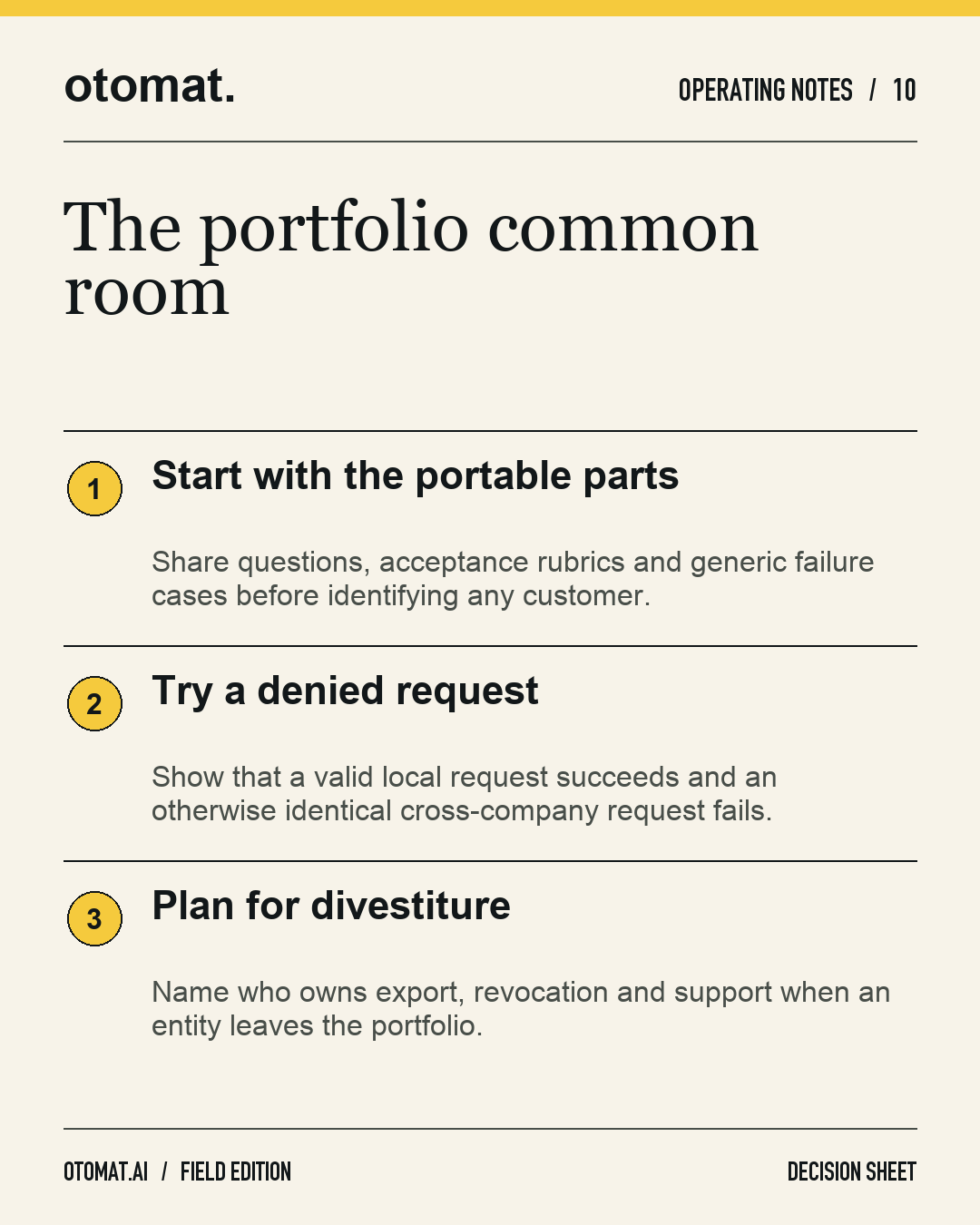
The portfolio common room

Share the test pack. Pause before sharing the data.

Two companies want a common service workflow. A shared purchasing process can help; pooling records can create a different set of rights and obligations. Procurement and data access are separate decisions.

Read the field test
  1. Start with the portable parts. Share questions, acceptance rubrics and generic failure cases before identifying any customer.
  2. Try a denied request. Show that a valid local request succeeds and an otherwise identical cross-company request fails.
  3. Plan for divestiture. Name who owns export, revocation and support when an entity leaves the portfolio.

Which parts of your playbook still work if the underlying data never leaves the company?

Slides (PDF)Decision sheet (PNG)
Read the full guide →

FIELD NOTE 11 / SMB CEO / transformation lead

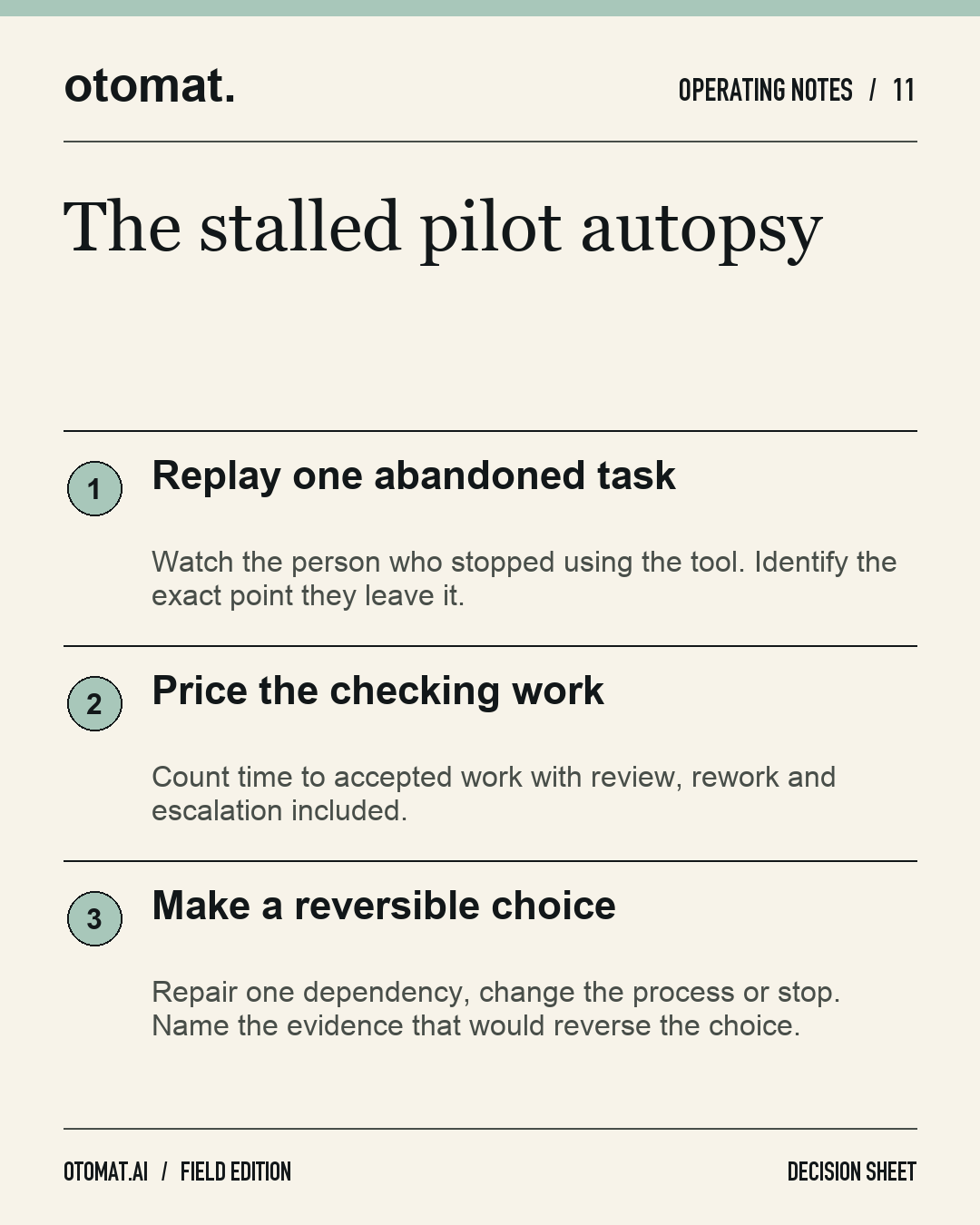
The stalled pilot autopsy

A stalled pilot needs a diagnosis before it needs a new model.

A service team likes its prototype but never uses it on shift. Maybe it takes longer to check a draft than to write one. Maybe the team cannot reach the source of truth. Those failures need different fixes.

Read the field test
  1. Replay one abandoned task. Watch the person who stopped using the tool. Identify the exact point they leave it.
  2. Price the checking work. Count time to accepted work with review, rework and escalation included.
  3. Make a reversible choice. Repair one dependency, change the process or stop. Name the evidence that would reverse the choice.

When did the last user return to the old workflow, and why?

Slides (PDF)Decision sheet (PNG)
Read the full guide →

FIELD NOTE 12 / PE GP / portfolio CFO

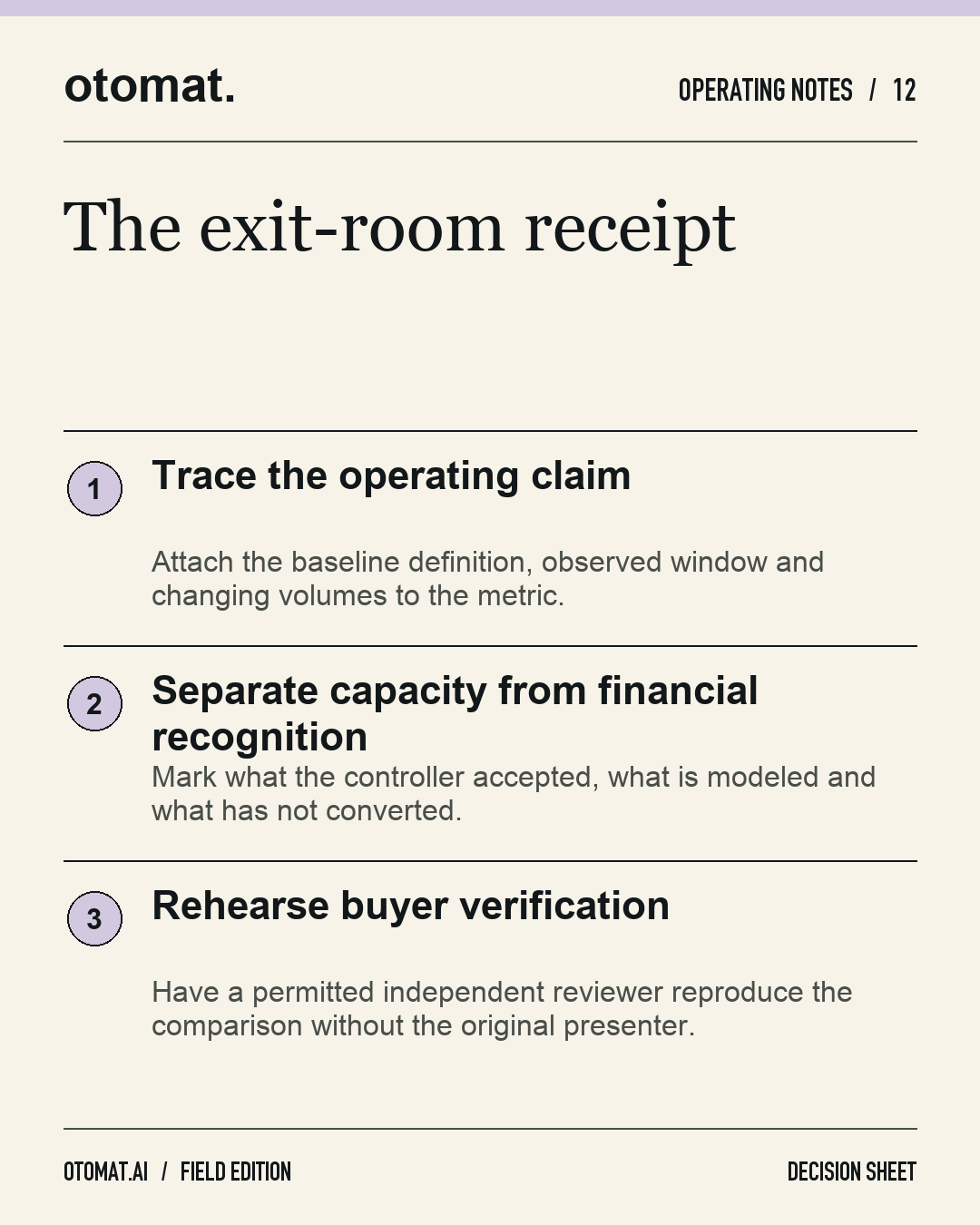
The exit-room receipt

Would a buyer believe this slide without the presenter?

An exit deck says an AI workflow improved turnaround. A buyer wants the baseline, the workload mix and the person who can run it after close. An anonymous chart on its own cannot answer those questions.

Read the field test
  1. Trace the operating claim. Attach the baseline definition, observed window and changing volumes to the metric.
  2. Separate capacity from financial recognition. Mark what the controller accepted, what is modeled and what has not converted.
  3. Rehearse buyer verification. Have a permitted independent reviewer reproduce the comparison without the original presenter.

What would you hand to a buyer who wants to test the claim today?

Slides (PDF)Decision sheet (PNG)
Read the full guide →

All operating guides · Book a Return Review